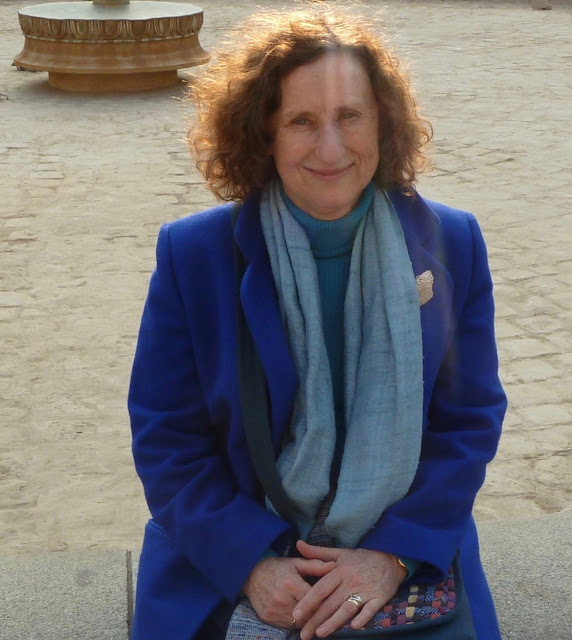
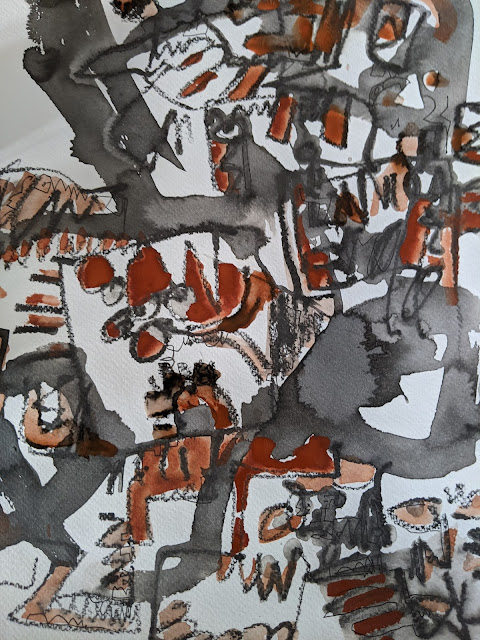
Clark Gormley is a poet and singer-songwriter based in Newcastle, Australia. He has been involved in organising and promoting local poetry readings for over 20 years.He has been published in several anthologies including Visions From the Valley, A Slow Combusting Hymn and Brew 30 Years of Poetry at the Pub Newcastle. He has written and performed three nerd-themed one-man shows, and is working on a fourth. He’s also written a bunch of wordy songs, most of which he has sung in the duo Nerds & Music. Gormley pursues these creative endeavours in an effort to counterbalance the stodginess of a career in chemical engineering.
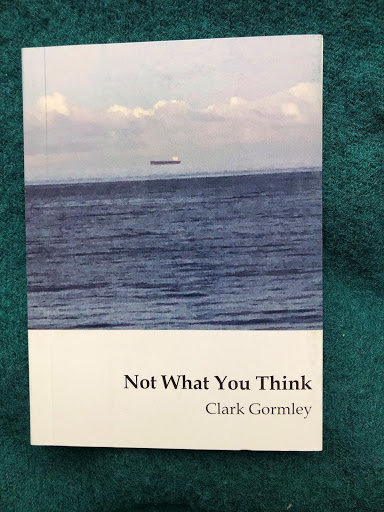
His flying islands book, Not What You Think, was published in 2019.
Much is on my website https://photovoltaicpoetry.com.au/, including a link to my new album based on my daily Pandemic journal, VIRUS 2020.
Poem
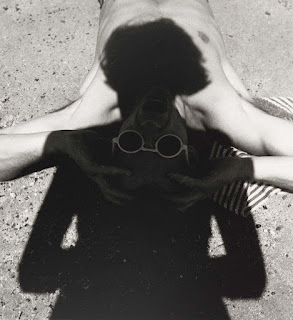
‘Take ekphrastic inspiration by responding to Olive Cotton’s The photographer’s shadow (1935).’
Here is my effort in any case, perhaps too prosaic, too much information, a tribute when I come to think of it, to a remarkable woman and artist. I wanted to celebrate a marvellous photograph, my favourite of hers.
‘A partial eclipse ~ Olive Cotton, The Photographer’s Shadow, 1935’
I sense her finger crouch, a waft of excitement, tempered
by darkroom apprehension. At first, you would prefer the heads
to align, but that would probably appear too contrived and lose
both Janus and that touch of Bresson’s decisive moment.
‘I don’t believe it’, shouts Max, hands on his head, or mimes
Munch’s Scream in a compact composition, flat origami,
lines and blocks in graded shades. Becoming familiar
with this chemical romance I’m sure this moment took time.
Her arms are sculptural, symmetrical, grounding the image
and they echo the relaxed arms of her model and lover,
her stand-over tactics prevent her nestling in his arms.
Max flops on his back, repetition with diverse consonants.
Thirties beauty was clean lines, fashion, stylish sunglasses
ignoring the beauty Polykleitos achieved using strict formulae
to chisel male nudes, stretching and relaxing athletic limbs
to embody erect perfection. After all, the gods take human form.
The gym body is now ideal but she muddies his torso,
doesn’t care to crop a swatch of swimming trunks
teasing an everyday aesthetic, ordinary glimpses
stretching time and place, if only we paid more attention.
Bush or beach are the Australian locations. Childhood friend
and later husband, Max Dupain, famously exploited the latter
(Sontag stressed, that’s what photographs do). Both children
played with Kodak Box Brownies, Olive’s ‘great awakening’.
The subjects are well known, well, hardly subjects, they float
through history, voiceless and paper dry in this brief eclipse
yet we share their vast circumstance of sky, heat and jaunty light,
the silver presence of the gulls, our noisy abrasive ocean.
One figure prone on earth grain, one ghost in negative radiance,
heads dead centre of the body, ephemeral . . . Have we become
too focused on images? Ekphrasis has been inverted.
100 million Instagram posts shared daily need more poetry.
Look between your legs. Go on, upside down, as blood rushes
to your visual cortex a giant locust hovers and a man vomits
an unkempt beard thirsty for play, surreal, artistic and ridiculous.
Have you decided? Scream or laughter? Rabbit or duck?
We can’t control what we see, mortality, scraps of beach-towel,
one vague nipple. Saccades give the game away. Men go for
the eyes then the erogenous zones, improvising love and eros.
They both loved shadows, increasingly rare phenomena.
~~
If you need a narrative this moment passed, their shadows stretched.
They left and went home for dinner. The country went to war.
Olive left Max for a new husband and his farm near Cowra, and
for children, isolation and poverty without electricity or water running.
I feel sad because the marvellous career of the photographer Olive Cotton
kind of stopped . . . she married another guy and moved to the country.
Shaune Lakin, curator
I was very happy, I loved the space and freedom. I never regretted coming here.
Olive Cotton
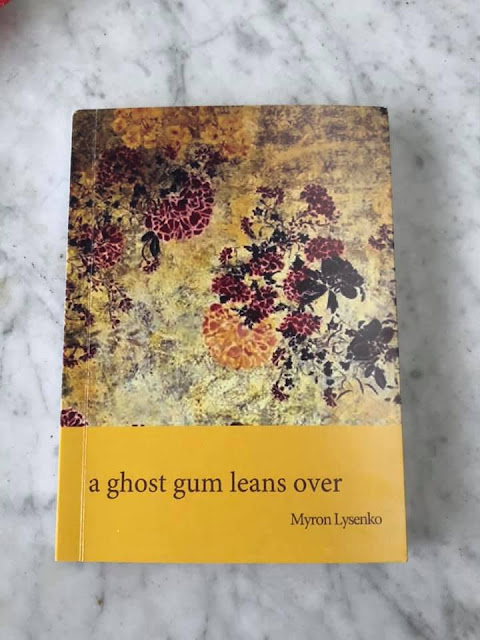
Myron Lysenko began writing haiku and senryu in the late 1990’s. He is the Victorian Representative for the Australian Haiku Society. He has published seven books of poetry, the most recent two consisting of haiku. His latest, published by Flying Islands was released in January 2021 and is titled a ghost gum leans over.
Myron has run almost 50 public and private ginko since 2008. A ginko is a haiku outing in a scenic spot where a group people gather to write haiku, then share, discuss and revise them.
His poems have appeared over 600 times in journals and anthologies around the world.Myron has been writing, performing, publishing, editing and conducting poetry workshops since 1980. He was a founding editor (with Kevin Brophy) of the lively independent literary magazineGoing Down Swinging from 1980 to 1994. They then passed the magazine on to new editors.
Myron is a poetry organiser; he was director of the Montsalvat National Poetry Festival, a convenor of La Mama Poetica, and currently runs the monthly reading in Woodend, Victoria Chamber Poets.
Myron teaches creative writing at the Woodend Neighbourhood House and is the leader of the poetry and music band Black Forest Smoke who have released a CD It’s Alright.
Books:
Coughing With Confidence Pets & Death & Indoor Plants I’m Ukrainian, Mate Winning and Losing Winning and Losing Again a rosebush grabs my sleeve a ghost gum leans over
You can see Myron reading his poetry or playing with his band here:
Here is the opening sequence from a ghost gum leans over:
sarcoma
(for Lucy Lysenko, diagnosed with Ewings Sarcoma on Oct 2008)
winter chill
the GP can’t explain
the pain in her knee
compost heap –
she rings to say her knee
has been x-rayed
nectarine blossoms
the teenager diagnosed
with bone cancer
x-ray vision
a rare bone cancer
in her knee
Ewings Street
is just around the corner…
Ewings Sarcoma’s here
did the specialist say
she may not need surgery?
medical jargon
taxi to hospital
she tells me to stop
telling jokes
she sets up a tent
at the Falls Festival
new crutches
the surgeon
replaces  her knee...
late summer heat
ambulance to Peter Mac
to begin chemotherapy --
perfect beach weather
Bloom Haibun
The pale and bloated teenage girl is lying in a hospital bed. There are cards lined up on a shelf above her head. The smell of dinner spreading through the wards is a warning that visiting time will soon be over. There are three elderly patients and four televisions in this ward but none of them are switched on. The girl’s father is at the foot of the bed with a cryptic crossword and her mother is standing with her arms crossed at the window. The oncologist is coming through the door.
rose petals
she begins to lose
her hair
leaves falling
in the moonlight
her nightmares
a blackbird
flies towards the moon
cancer ward
winter wind
she cries on her way
to more chemo
chemo no. 9
after her constipation
diarrhoea
she flies to Sydney
to see her favourite band
infected PICC line
her port
malfunctions…
chemo postponed
on crutches at a party
she falls onto her knee
Oxycontin tablets
low platelets
her immune system
is zero
closed pink coffin
her bald teen friends
cry together
black orchids
the pain in her knee
is still there
her kneecap rubs
against her inner thigh bone
nectarine buds
last rounds
of chemotherapy
empty bed
remission
she books her tickets
for a holiday in Europe
end of chemo party
I perform a song with a sing along
cancer chorus
six years cancer free a day full of rain
her positive results
on the ten-year check...
a new tattoo
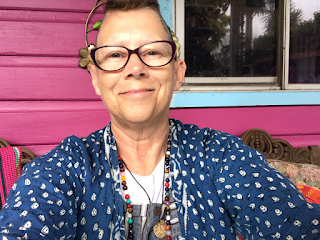
Kerri Shying is a poet of Wiradjuri and Chinese family, publishing across many journals and anthologies.
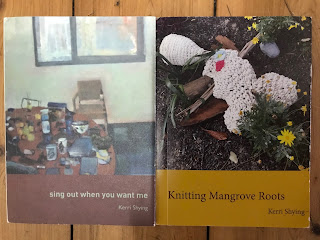
She is the author of a bilingual pocketbook of poems “sing out when you want me”,2017, Flying Island Press, “Elevensies”, 2018 Puncher and Wattman and “Knitting Mangrove Roots”2019, Flying Island Press.
Kerri held the Varuna Dr Eric Dark Flagship Fellowship for 2019 for her current collection ‘Know Your Country” 2020, Puncher and Wattman, and was shortlisted in 2017 for both the Helen Ann Bell Prize and the Noel Rowe Award.
Kerri has been convenor of Write Up for 5 years, a free arts/writing group for people living with disability.
She lives with disability in Newcastle, NSW with her famous dog Max Spangly.
Kerri is a nominee in https://theaspireawards.com.au 2020, an activity of the Human Rights Commission, for disability activism in the arts.
Gumar
Speaking – Uncle Ray Kelly snr
what i’m doing   today    wishing i was

with   the bronze winged pigeon   cousin
she’d make me laugh   the hairless cats

the dachshund made of ball bags  pickled
grey pink asked her once if an animal with

hair arrived   at their place would they shave it
she made that face  that went back years

crossed the generations   we are the arms
the legs the bodies mouths speaking gumar

spilling laughter    hiding  feathers
Emptying tea leaves in autumn
this half moon   golden   stuck

by mist along the nest side

of the yucca tree   night

calls winter       one quilt

        nestling animals   grown indoor

in weeks


books and porridge

talk to me from behind

say  its time for fire

we’re waiting on


the other side
Nothing like Nimbin
suffering   the climate doesn’t

lend itself to   real hard  scour

for the poor   see the bastards
loll   about in board shorts

growing veggies  like the climate

eggs them on  a failure

to participate  is no great thing
the ferals    like the old blokes say

some in every town  back out where

the dairy farmers were  before the soy
the nuts   the milk that went the way

of lard
I’ve been running round all week

on the chase   for how much heroin

it takes to kill a normal person

just try coming out with that   and

they say decency

is dead
I wish it was you
before you get    the wrong end

of the stick      in my own defence

I have to say   love is

consensual    the underclass

could mind their business too
I’m knitting mangroves    root by root   surviving

night and day    the inrush of the tides  i’m

waterlogged I’m dry   I’m all the decades  of fringe sitting

knitting  and unwinding   telling    keeping secrets

all the words destined to wash up    this
kitchenette my laundry torn apart by crabs
sluiced to sea    relying as I do on you   the moon

aiding and abetting   sun   if they can prove it

so many other crimes    I live between the heat the bats

this under over     day and night    the leaves the

tips the roots the air the water   knitting    all the time
parental advice
you can disguise the way

your past stinks

            fake a shallow grave      just

            halve the normal depth   so your decoy

fuckwittery can be inserted

as a gravel bed   to divert a nose from

sin        guilt      shame

your belief that

others ought not  look your

            way

            again
you

take the corpse of something small       a

crime of less significance                       classic

            is the body of a dog

            to hide the remnants

of a man
let

the finding of the one   account for the stench

of that it pains you to explain    admit

account for nothing
Kerri Shying is a poet of Wiradjuri and Chinese family, publishing across many journals and anthologies.
She is the author of a bilingual pocketbook of poems “sing out when you want me”,2017, Flying Island Press, “Elevensies”, 2018 Puncher and Wattman and “Knitting Mangrove Roots”2019, Flying Island Press.
Kerri held the Varuna Dr Eric Dark Flagship Fellowship for 2019 for her current collection ‘Know Your Country” 2020, Puncher and Wattman, and was shortlisted in 2017 for both the Helen Ann Bell Prize and the Noel Rowe Award.
Kerri has been convenor of Write Up for 5 years, a free arts/writing group for people living with disability.
She lives with disability in Newcastle, NSW with her famous dog Max Spangly.
Kerri is a nominee in https://theaspireawards.com.au 2020, an activity of the Human Rights Commission, for disability activism in the arts.
Here’s some Elevensies from “Knitting Mangrove Roots”
saw his hands  stimming over lies

and thought    it’s good you’ll be gone

soon   those buckled bulbs  for

fingernails   the giveaway  of a heart

about to blow   the eloquence of illness
far surpassed the itchy dogs that fell limping from his mouth
nothing he said worth a dollar on the

open market   no exchange rate    for

who’d pay  some stories   ought

to die   those names for things  rubbed out

in the sand   the beginning    it was the word
why can't you whisper  it to me

has it got to be this  shout from

one day to the next    every sinew

pulled up hard   each movement

 effort to caress what  ails    the
buttress on a falling wall with sticks
is how i see my mind  these days

one more  pill in the phalanx  that wheels

across the week  this skirmish  or another

there is no battle    just a little less

 nothing  can be won
someone   mentioned  relativism

in a tv show and    i thought that’s

about as café as the conversations

get  if you aren’t working   maybe

if you are  pissed you get a chat   to live
in the revolving door of commerce
the life social  that’s the glitter the

edible gold  in your champagne   stand

here and watch   the yearly immigration

like koels  the cab doors slamming at

2am  we raise them then they go
cream blossoms  take a drench

beside the house the lotus pond

refills   a season  grows we have

no thought to name    the fifth

among   the too cold   too warm
here where people of the just-enough-land
pride themselves on  common

ground   this anomaly unsettles

like the lady doctor  speaking

in the house   today  answer  best

to turn your back and go the other way
three  o’ clock all i’ve had   is one cup

of coffee  soy milk     i try to imagine

eating    the fridge  is full    so full the door

fights back   listen  to my tongue   stinging

a rebuke   go on   eat your tea
beside my heart i hear the acidness of hollow
space   pause   if i have grown to like the gnaw

my juice on flesh  my spine  a pinion to the bed

go  now hear the lettuce see the ham all wrapped

in calico  boil  rice  at least    it’s the anxiety of pain

i tell myself    you don’t have to make a meal of it
drought is in our faces now   the sea

the blue distraction   no help from

the dusted wind   i hear the back door

slamming   like a drummer    why

not rub it in    where did we think
the topsoil of the country would stay
not a drink to wet it down   roots

so far forgotten  they are frailer than a

thought   death lasts longer   the whole place

is on the move   still we  can’t modify

a thing   until our nostrils   cake
Some covid-19 poems; us lot had to isolate more and for longer but had more experience of isolation. Maybe we did better?
Mr Whitmont
jam your hands

in your pockets

of your suit

at the lights
I wanna see

your arse-peach

tight against

woollen superfine
business men

come back

with the right slits

shroud hips
zoom has let me down

I'm ready for the show
wakings
whether 8am or midnight lately

have been calling for attention    where

none is due      no bus to catch and still the

call to regimen a stump jump plough    persistent

hooks   the tender lobe skin   skull bindings
lacking that flying buttress others
strain against demands   that ping in on

the minute       insistent  spruikers

human potential      what a movement

what a trip to nowhere    sells you a police

hat and cuffs     says here    arrest yourself
emperor of nothin in the land of nowhere
quaking in our boots  by the billboards

gather   too much too late         wickedness

and words   that change directions like the

swallows  of that facebook viral video
we all sought  to marvel            lost to hard work

holding out for images  seated in the

deckchairs        with one hand full of helium

balloons           fantasy of forward

upward   sky-high    imaginings of riches
what's deserved is        never what we get

yesterday I swapped  a metal headband and

a floral garland  for three large lemons  at a

table up the street       they were out of

lemonade         I           fresh out of coin   the true

transaction                   that we met
GREETINGS FROM FRANCE…. Salut aux amis de la communauté FLYING ISLANDS !
BIO
Béatrice (Anne-Marie, Marie-Jeanne) Machet is a French born poet, living between France and the USA, whose dance lessons as a child influenced and still influence her writing. As a teen she learned a lot from the Native American point of view about Native American history and Native cultures, until she felt impregnated with them. After having been involved in the French science-fiction milieu, flirting with cartoons and magazines such as Actuel, Charlie Hebdo, Fluide Glacial, she met Jean-Hughes Malineau, a Gallimard editor, who encouraged her to begin a career as a poet. From this initial meeting, each published poetry book of hers will testify to an evolution in her writing practice. Since 2016, she is an active member of the sound poetry group Ecrits Studio (ecritsstudio.fr). At her credit some 15 books and 30 chapbooks of poetry (three of them in English) plus 7 Native American poets’ collections she translated into French, and four anthologies gathering 40 Native American contemporary poets whom works she translated into French.
She is used to collaborating with artists from all kinds of disciplines such as painters, sculptors, musicians, composers, video-makers, dancers and choreographers, and with whom she performs her poetry. She is on editorial boards of French poetry magazines such as Recours au poème, Sur le dos de la tortue, Les cahiers d’Eucharis.
She is regularly granted writer residences, is regularly invited in international poetry festivals in France and abroad. She leads creative writing workshops, is called for teaching and performing in schools and colleges. She gives lectures and conferences about contemporary Native American literature. She also launched and created Radio cultural programs, poetry oriented, from 1984 to 1986 and from 2018 to nowdays. She is responsible of and produces a monthly radio program (Radio Agora, Grasse) dedicated to contemporary poetry.
Partial Bibliography- poetry exclusively
– Dire, éditions Clapas, 1998, forewords by Patrick Joquel –Tunkashila unshimala yé ( imprégnation peau-rouge ) 1999, éditions Clapas (recorded and performed on an original music by composer Jacques Dudon) , – J …., éditions L’Amourier (poetry) 1999 – Eye-liner, 1999, éditions Clapas, with afterwords by Armand Olivennes – Dyptique, 2000, éditions Clapas with forwords by Alain Jégou – De quoi s’étonner encore de vivre, 2000, éditions Encres Vives – Aspects de la poésie contemporaine des Indiens d’Amérique du nord, 2001, L’Amourier 2001 – Dans l’atelier d’Henri Baviera, 2001, Le Garage (MDLC 2 place Auriol 83510 Lorgues.) – Dédicace, 2002, éditions La porte – Canku (the way in Lakota language) with painter Gérard Serée, 2002, atelier Gestes et Traces 2002 – Muer, 2003, poetry, éditions L’Amourier – Passage au méridien, 2003, éditions I.H.V – L’essor et l’écart,2004, atelier Tactiles with painter Corine Léridon – La sentinelle, 2004, atelier Tactiles with painter Corine Léridon – DVD- painter Violette Adjimanand poet Beatrice Machet, 2004, centre d’art SEBASTIEN (LB productions) – Tribus, 2005, Atelier Gestes et Traces with painter Gérard Serée – Retentir, 2006, with painter Youl – Lumières, 2007, with painter Youl – Le felo va parler, 2007, bilingual chapbook, Amastra-n-Gallar (Galicia España) – Lacérer, 2007, éditions La Porte – Der de Dre, 2008, éditions Voix – Possible, 2008, with painter Youl – Ouest-Nord-LAZA-Est-Sud, 2009, bilingual chapbook, Amastra-n-galar) – Une poire pour William, 2009, with painter Youl – Marge, 2009, éditions IHV – Melisma, 2010, éditions SD with painter Sylvie Deparis – Venus rising (poetry anthology 2009, The Bass Press, R and R editors,
– Hadziin, 2010 (The one Who Speaks in Apache Language), CD, poetry spoken words with composer Michel Chaupin – ACCOM(plissements), 2011, CD, poetry performance recorded while granted a writer residency at « la maison de la poésie transjurassienne ». – Le livre M, 2013, crafted book exhibited at la maison de l’artisanat d’art in Marseille and in la maison Carré in Nîmes.
– Macao, A Grey Epic (bilingual), 2014, ASM Press – Les Gens-pierre, 2014, with painter Henri Baviera – Les Lacets, 2014, atelier Gestes et Traces, with painter Gérard Serée – Rupture en quatre leçons, 2014, éditions Approches – For Unity (bilingual), 2015, Pocket Book, ASM Press – Salse sans pareille, 2016, éditions Le petit véhicule – Du dernier souffle, 2017, éditions du Frau – Les mots fendre, 2017, éditions Lieux Dits
– Der de Dre addendum, 2017, éditions Voix
–Jamais le dernier souffle, 2018, éditions Peycervier, with Painter Henri Baviera
– Tirage(s) de Tête(s), 2019, éditions les Lieux Dits
–After Gertrude Stein, coming out date April 2021, Dancing Girl Press
***************************************
NEW WORK – (in progress, just a beginning)
QUEST-ION(ing)S OF TIME
1 )
Was it a-

       or b-

              fore….

                           thus I hit the slopes of the alphabet

a true bare-footed race

with faux-pas on slippy pebbles

the very one I spitted

after having practised

tongue-twisters

and breathing exercises …

there followed a free ride

a screeching slalom

between letter-poles

a super-giant choreography

as if a baited tale was told

in the tracks of caged slides

as if a vision

could heal sounds and meanings

through a world record expression
2 )
« One exerts power

                       over time

when one masters distance »

very well then

deciding to keep its distances

staying away from ticking and stopwatch

my tongue exerts power.
But are words manageable

as for language

… when is it fully realized ?
when is it born

with its flow of blood and tears

from a womb called self ?
and how the speed factor

gives a voice its energy… ?
Relatively intruder enough

flesh

in the form of larynx and palate

is the poem made power

sung

and blown out like a mushroom cloud.
3 )
this is a tiny here

this is a vast now

on a crest of wavy time when

every second is sup-

posed to up-

sidedown your mind-will

which is swallow-

ed sliding and plunging in-

to an ocean of enzymes and acid

so that every protein of it is broken down

     when your lop-

     sided stomach is digesting prim-

     al scream till it is dis-

     mantled and pour-

     ed down the guts
a creepy wreckage stuck

in what will be its last curly den

     and then …
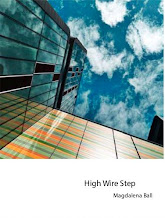
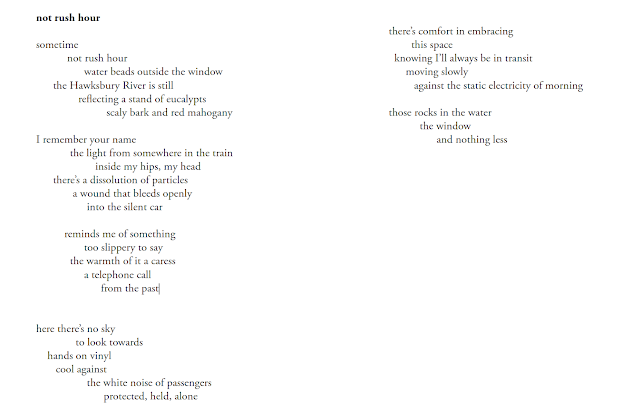
Magdalena Ball is a novelist, poet, reviewer and interviewer, and is the Managing Editor of Compulsive Reader, a literary review site that has been running for some 23 years. Her interview podcast, Compulsive Reader Talks, has over 150 wonderful interviews with the likes of Maria Tumarkin, Ben Okri, and John Banville, to name just a few. She has been widely published in literary journals, anthologies, and online, and is the author of several published books of fiction and poetry. Her Flying Island book, High Wire Step, was published in 2018. Her most recent publication is Unreliable Narratives, published by Girls on Key Press in 2019. A new poetry book, Density of Compact Bone, is forthcoming from Ginninderra Press in 2021.
JEAN KENT was born in Chinchilla, Qld, in 1951. She published her first poems in a literary magazine in 1970, while she was completing an Arts Degree (majoring in psychology) at the University of Qld; her first collection, Verandahs, appeared twenty years later, in 1970. Since then, another eight books of her poetry have been published. The most recent are The Hour of Silvered Mullet (Pitt Street Poetry, 2015) and Paris in my Pocket (PSP, 2016).
Awards Jean has won include the Anne Elder Prize and Dame Mary Gilmore Award (both for Verandahs), the Wesley Michel Wright Prize, the Josephine Ulrick Prize and Somerset Prize. She has been a runner-up for the Newcastle Poetry Prize and winner of its Local Section, and was a judge of the prize in 2013. She has received several writing grants from the Australia Council, including Overseas Residencies in Paris in 1994 and 2011.
As well as writing poetry, fiction and (occasional) nonfiction, Jean has worked as an educational psychologist, counsellor in TAFE colleges, lecturer in Creative Writing, mentor and facilitator of poetry workshops.
With Kit Kelen, Jean was co-editor of A Slow Combusting Hymn: Poetry from and about Newcastle and the Hunter Region (ASM/Cerberus Press, Flying Island Books, 2014).
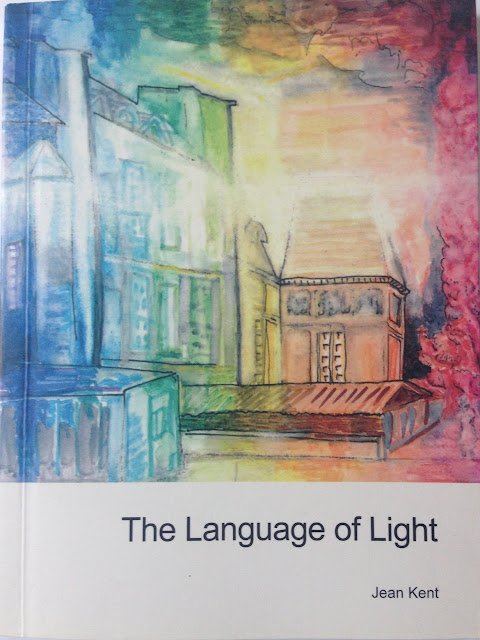
Her Flying Island pocket book is The Language of Light (2013), a selection of her poems with Chinese translations by Iris Fan Xing.
In 2020, Kit Kelen invited her to converse with him by email for his blog spot, The Daily Kit. Their conversation over six months, covering a lot of topics, including poetry, but also COVID19, the deaths of their mothers, gardening … and some very recent drafts of poems, can be read here:
Jean lives at Lake Macquarie, NSW. Her website is jeankent.net.au
Views from the desk, Kilaben Bay
Some Poems
A PLATFORM FOR LEGENDS
On the verandah of my grandparents’ house,

the day falls asleep around me.

This is the roof of my childhood.

And this, the floor. Tin and wood:

silver-grey, sibling corrugations.

Like platforms for family legends

they wait, rehearsing allegories

as if it is always the end

of a sun-limp day, the lucerne cut,

wheat bagged and a needle in the hessian

beckoning its tail of string.
In the fragrant dusk, soil settles.

Crickets, ants and unseen lives

team over cracks in black earth’s surface –

years are strung like tales of Min-Min lights

along this world of roof-creaks,

board-sighs, a home paddock barracking

for the far-off calls of dinner plates,

falling tablecloths, cutlery and relatives.
Time melts here. Ghosts with glasses of Scotch

catching the last day’s light in their hands,

bend their knees, ease back

into squatters’ chairs. I wake.

A cool breeze is balancing

beside the verandah rail, roping it

and ruffling off, up into wisteria leaves:

sitting tenants now, under the roof.

Time melts. On the ends of long wooden arms,

ice, moonlit, hugs the air.
JEAN KENT
(From Verandahs, Hale & Iremonger, 1990; reprinted Picaro Press, 2009.
Also in The Language of Light, ASM/Flying Island Books, Macao, 2013.)
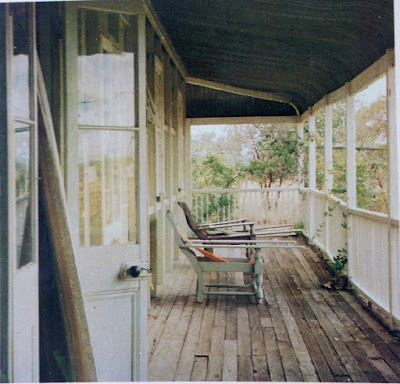
(The verandah of the old family home, Weeoomba, Qld)
QUARANTINE CAMP, 1919
After the tents of war, now the tents of Wallangarra:

one last quarantine before the unfamiliar family

can escape to what they hope will be a home.
Seven days—seven and six a day—

under the sheltering granite ranges, fires

heat drums, the coats of the women skim just high enough

to escape the frost, the men in their new civvie uniforms

stand stiff as saplings, not happily transplanted, yet.
On the bare ground by the railway,

they should be thankful prisoners.  So many huddles—

and in amongst them, this trio who will step away from here

into my family history: one man, his wife …
and a two year old girl, confronting this stranger, her father.
Just beyond the wahlenbergias, the shy native bluebells

at the camp’s edge, are the Pyramids of Girraween:

bald monoliths, made by volcanoes, not men.
Half a century later, I’ll try to climb one …

But it is too early for a returned soldier to brave

that skyline—better to bivouac here, picking bluebells,

waiting at dusk for a wallaroo in its shaggy greatcoat

to do a reconnaissance of this temporary invasion—

negotiate with it for peace.
After the certain attacks of war: now world deaths

from Spanish flu.  In this border camp, learning to speak

with the wary trust of the child, what can my grandparents do

but hope they have outrun the final assault?

In training for a domestic truce,
trust there will be a tomorrow soon, flinging over them

only a tent of sky—as wahlenbergias, those fallen-

sky flowers, cheer the edges of the last road home.
JEAN KENT
(Published in the Weekend Australian Review, 12th Sept 2020)
THE LANGUAGE OF LIGHT
Weekends, Paris walks.  Something shifts

underground.  Like a Rubik's cube

slightly twisted

the lines of colours realign, the harmony of humans

gently shudders the city’s symmetrical grid.
Like the still spaces we enter when music

moves us, weekends separate us from the deafness

of habitual days.  More so than ever

here, on the other side

of our usual world —

here, where we live lit up

like cymbals always on the verge

of being struck.  In the Luxembourg Gardens

I am one small vibration in the shivering of the city

toward some Sunday song.  The babble of all the world

is being quietened here —
Poles and Italians, Australians and Africans,

small boys and motorised boats all blend into a buzz

swarming from under the acid-yellow horse-chestnut leaves

toward the end of summer’s silver

hived within the lake.
Weekends, Paris talks with less tension

accelerating its tongue.  Even the tourist buses —

clattering to halts like the abruptly dropped snakepods

of bauhinia trees —

release people who become, after a little time here,

as calm as seeds

waiting to be planted.  We almost believe

we could all belong — as we settle briefly

on these wrought-iron chairs with their ringletted arms

and verdigris-barred backs.  We subside
on seats tattooed all over with holes

spraying sunlight onto the crushed white gravel below.

How many faces

have fallen here —

waiting for Paris light to persuade them

to float back up, to lift

towards it their first foreign shoots?
Weekends, Paris walks.  It stalks us — as gently

as the grandparents we never knew, those ghosts

who passed through a war here

eighty years ago.

Like the nano-shifting of volcanic plates now,

something in us shifts.  Whatever homes we thought

we had brought with us

settle like hidden pockets

in our winter coats — and we join the long lines

of stilled people in black swivelling towards
the slightest caress of sun.  The light,

as it negotiates peace settlements

within this temporary country

of cold shoulders,

is speaking everyone’s ancestral tongue.
JEAN KENT
(From Travelling with the Wrong Phrasebooks, Pitt Street Poetry, 2012;
also published in The Language of Light, ASM/Flying Island Books, Macao, 2013.)
she

            taping people from her village

            The Peloponnese in an agrarian past

            collecting voices that will disappear forever

            then standing on this edifice

            to look backwards

            and then deeper, into the 18th century

            now like a roaring train, a novel

            the history of Greece, so tragic

                        she says
another she

doing genealogical research

first the family

the migrations, then back

back to the island

     becomes

                 becomes a whole history

Ithaca

the Venetians

the Turks

the Byzantines
very different, she said

                 we had war
in one of her windows

the mandarin tree stands

in the centre of a brick paved yard

on another window

the lace curtain

shields the lemon tree

180° of glass

the vlita, the horta in the garden
this beautiful peaceful space
In another window

                 Skype video

                 I see them

                 doing genealogical research

                 and he also doing genealogical research

                 and the search on our name

                 a Byzantine tangle

                 a clan under the radar

                 maybe secret Turks or secret Jews

                 escaping the Inquisition
they had records, you know

                 the Venetians

                             so Ithaca is a different matter
I hold up the page of the book

to the Skype camera

                 this proves there were Couani’s on Kastellorizo

                 a page from this old book

                 strangely printed in landscape orientation

                 with the list of boat owners – Κουανης
and he

                 on video Skype

                 an English life

                 reaching back to France, Egypt, Africa

                 finishing an autobiography
I sit in her living room

a window opens

I see him
Sky
the fairy story effect
the magic of childhood
Sydney in a snow dome

possible because of its

bowl-shaped geography

ringed with mountains

girt by sea

its foamy cliffs
the sublime
people

miniature

the sky

so vast

the clouds so high

and puffy in the southern sky

the higher one, gleaming white in the sunlight

whiter than white is

is it so big

or are we so small?

showers coming and going

humid, then a shower
from above

the land is full of water and sunlight

a shower falling on one small area

shadows and sunlight
Reminiscent of Blackheath in The Blue Mountains and its fabulous summer alpine climate, air constantly washed clean by afternoon thunderstorms, sublime mountain vistas. The 19th century children’s novel, Heidi, set in alpine country. The snowy white bread rolls wrapped in crisp cloth and Heidi’s little gingham swag with her belongings in it. Heidi, so lucky to be an orphan.
people swim in the rain

raindrops cool on their skin

in the pale aqua water
The fact that it’s aqua because of the chlorine feels irrelevant, especially on sunny days. It’s not unlike the colour of the water around the Mediterranean islands. The pool, in the park just next to Broadway.
Broadway, Sydney’s busiest intersection, just erase the traffic and the noise and you’re left with a perfect landscape. I’m dreaming of turf being laid over Broadway like they did on the Harbour Bridge for a day, except permanently.
a flock of corellas

with their pretty call

circling

and doubling back
Broadway is like a bowl or part of a bowl that empties into the harbour at Blackwattle Bay.
Sublime, the depth

of the harbour

a mirror of the mountains

valleys that continue

downwards

but now, into murky depths
Is childhood magical? What is the temperature of the sublime? How we loved Caspar David Friedrich in the early 70’s! Before we were ravaged by Conceptual Art, that is. That’s when many of us stopped painting, when painting died for us, replaced by the minimal gestures of others, requiring no effort and almost no thought. Somnambulist Art. Work they did between hangovers.
The whispering quiet of the

valleys from the cliff tops

transcendent, individuating

rupture in disguise
the sublime thing

I could have gone that way

with feminist representations

some did

that’s where I was wanting to go

drawing female figures falling into chasms

so much like

classic Romantic images

it was men who dissuaded me

but 10 years later

similar images were

visible

in the art galleries

Vivienne Shark LeWitt etc

but then with the

imprimatur

of some art world bureaucrat
incommensurability

that was the problem

between them and us
I met people who understood why you’d want to rail against the parochialism of your peers
Australian Art

it’s a joke

and in Australian minds

it’s all happening elsewhere

distance creates the sublime
not that there aren’t fabulous artists here

but don’t tell me they’re Australian
So my work became

what was possible
maybe constraints help us

to map the unknown
aesthetic unboundedness

rupture
I made small drawings using pencil and aquarelle. Some like an abstract Reg Mombassa, some hyper-real. Learnt the Chinese method of watercolour painting. Wrapped up in teaching art to people who didn’t want to be artists. I took a holiday from history.
thinking

Communism, Utopia

group projects

where every offering

is valued

and adds


another element to the lexicon
The haunting
the bamboo pen

the ink well

vintage glass thing

with its pressed pattern

and three wells

the paper ready

the concertina book

carried around for weeks

where the practice drawing

will occur

also

the sketchbook

the real thing

started

cover done

title chosen

first poem

printed on tracing paper

and glued in

with spray adhesive

photos of all the objects

taken and uploaded to ipad

there

accessible

waiting

all the preparation done

the pen haunts me

I think and dream about

picking it up

I can feel the sensation

of moving the bamboo

across the paper

think about it constantly

imagine the black ink

sitting in the ink well

and about two other colours

as yet unchosen

I mentally scan the box of inks

think about the beautiful

senegal yellow

thick and glowing

everything is ready

and yet

the series consists of drawings

of objects from my parents’ houses

both parents now gone

so objects are not objects

it is essential to choose the colours

at least for the first drawing

the amber cigarette case

and think

is this a gestural exercise

or will each drawing

take on some complexity

become a painted image

become watercolour

water

always there

at the ready

to sooth


now that we’re really alone
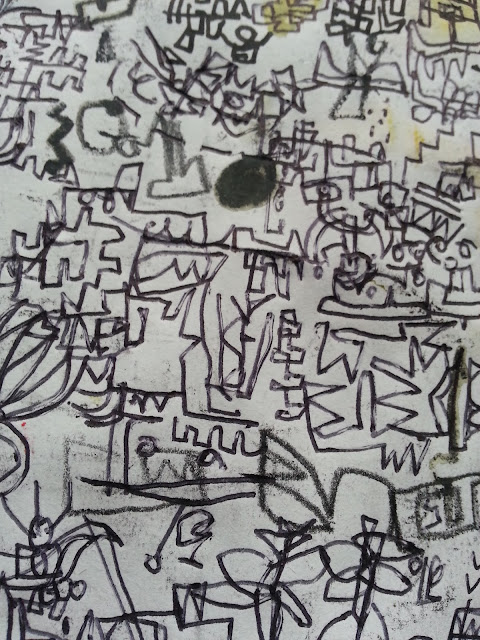
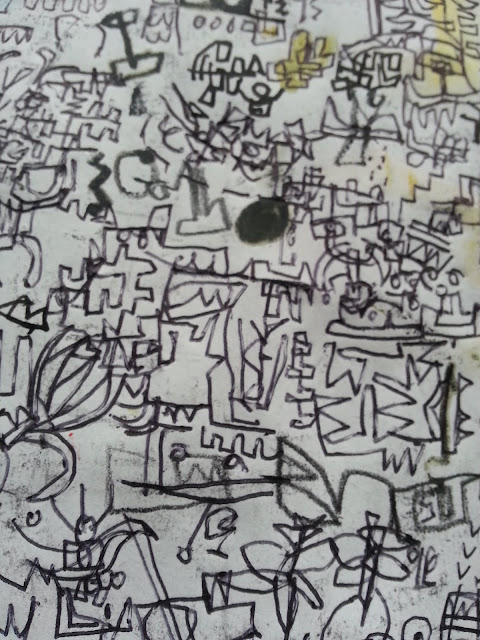
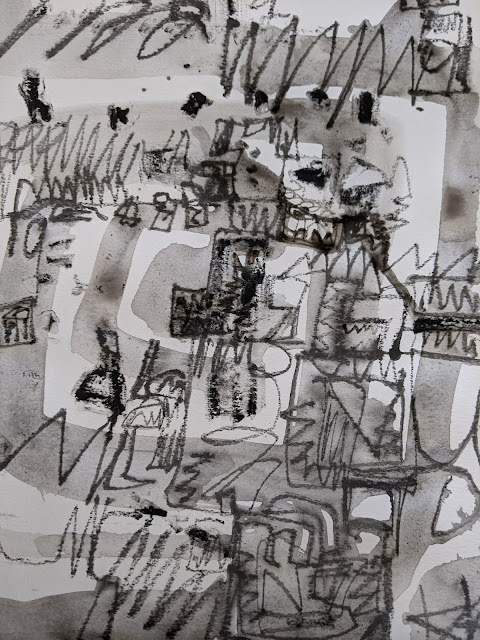
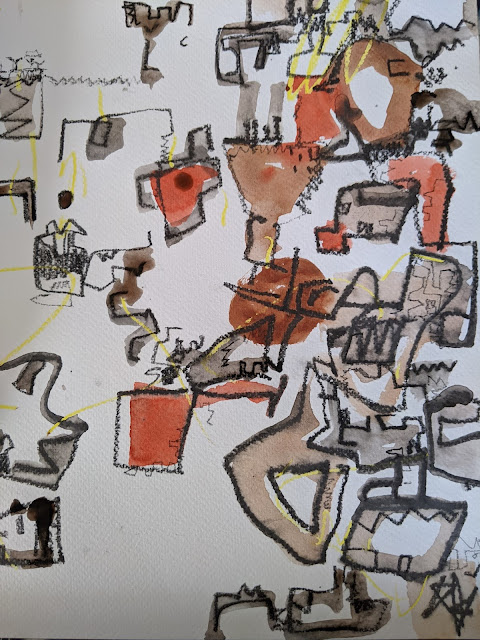
Christopher (Kit) Kelen is a poet and painter, resident in the Myall Lakes of NSW. Published widely since the seventies, he has a dozen full length collections in English as well as translated books of poetry in Chinese, Portuguese, French, Italian, Spanish, Indonesian, Swedish, Norwegian and Filipino. His latest volume of poetry in English is Poor Man’s Coat – Hardanger Poems, published by UWAP in 2018. In 2017, Kit was shortlisted twice for the Montreal Poetry Prize and won the Local Award in the Newcastle Poetry Prize. In 2019 and 2020 Kit won the Hunter Writers’ Centre award in the NPP. He was also shortlisted for the ACU prize in 2020. Kit’s Book of Mother is forthcoming from Puncher & Wattmann in 2021. Emeritus Professor at the University of Macau, where he taught for many years, Kit Kelen is also a Conjoint Professor at the University of Newcastle. In 2017, he was awarded an honorary doctorate by the University of Malmo, in Sweden. Literary editor for Postcolonial Text and Series Editor for Flying Islands Pocket Poets Series, Kit has mentored many poets and translators from various parts of the world, and run a number of on-line communities of practice in poetry (most notably Project 366 [from 2016-2020]). Kit is a Fellow of the Royal Society of NSW. You can follow Kit’s work-in-progress a the Daily Kit. Kit is the Co-ordinator of the THESE FLYING ISLANDS community blog.
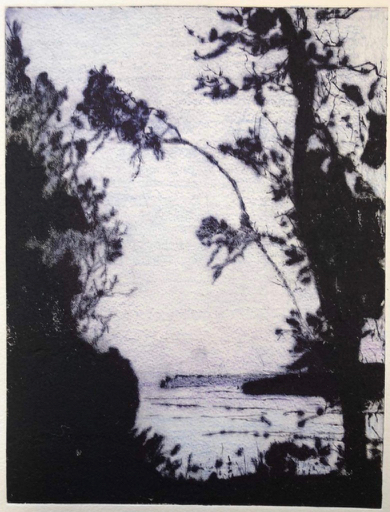
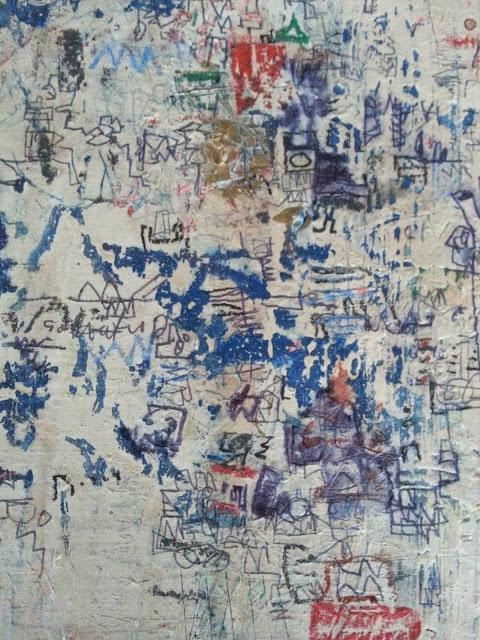
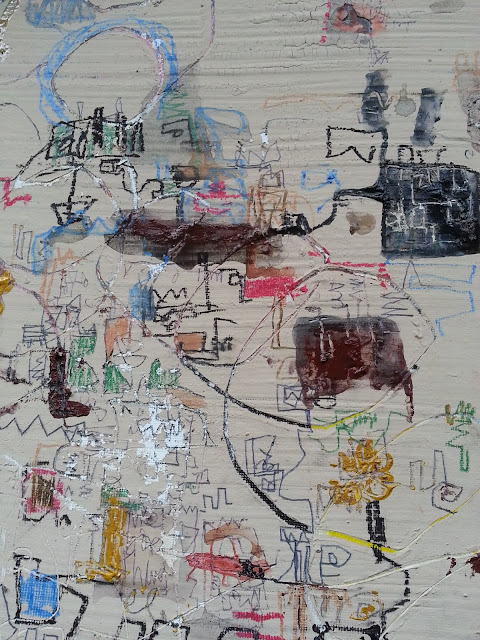
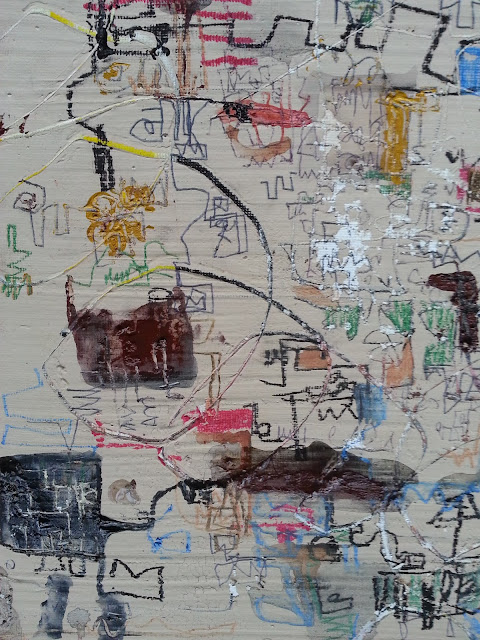
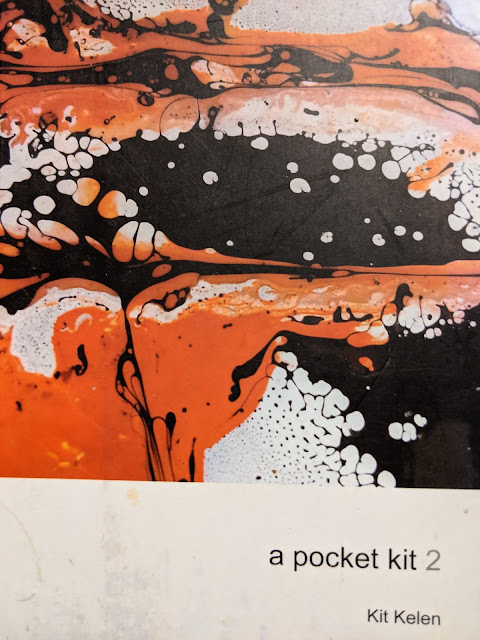
Here is a little selection of poems from Kit’s book a pocket Kit 2, interspersed with some paintings and drawings:
let everything grow wild today
embrace the poem
squander the soul

sleep to dream and wake to play

let everything go wild today
let the spirits call our names

let us requite
only the words
to bear
from my door

nowhere but the way
everything green is reaching for heaven
for light and for love
squander the paint

set afloat in a poem
only words
to be borne

to bear on
let everything go wild today

wake to play and sleeping dream
so we may work the miracle

set God and godly things

all free
today

let everything grow wild
A Sociology of Paradise
First I came through a hoop of flesh.

I didn’t jump, I swam. There was an endless

mud plain and another storm coming.

Rain beat the rice shoots green from the soil.

Millions were huddled round the still ether.
The century dragged on. I missed the boat

swam out to the island. And the air was still

in the sun’s quarter and the half a sky where

waves could have been. The moon washed

up where the tide rusted into the sand.
Cars came out of the twentieth century.

Coca Cola came ashore, lapped on

the hard live shell of paradise. A coconut

fell out of nowhere onto my child’s head.

I didn’t stumble. There were stars and bars

everywhere. I could hear the West

crackling through looming shadows of bliss.
Back country, hills were dense with trees,

Dissidence, notches for climbing up.

And curled into a noose of straw

the disappeared hung, swaying – invisible

burden of paradise. I jumped through a hoop

of gold. I had the ring of confidence then

and a flag colour of mud.
Helicopters filled up the sky. When the noise

came, birds shifted in a line, black, palm to palm,

fifty metres. Then when they came back

there was nothing the wind could move.

Trees clung to a rock in the sea.
On dry land a had a good steady job

in the fly-spray factory. They paid me in cigarettes

so naturally I took up smoking. The mist

from the nozzle formed up a halo to martyr

the very air. You couldn’t call it a leak.

It was more like missile testing.
Each day here proud of the fallen, brainless

slaughters to glory in. The earth makes up

a place for each. The new rice sings from the earth.

The colour of the mud in our veins is a flag

billowing over a hoop of bright gunmetal:

the welcome mat. I didn’t jump, I swam.
the priming of a painter’s canvas
like night come

colour no matter
skins are under skin

and skies too
shade patches, dapples take the tune

soaks pigment where the eye was caught
canvas is linen really

like a tent clouds abide in
there are rats have your pants

vultures all sorts
one lies down in it all

till the rags make ladders
next beanstalk’s got your name on it

next stop is the stars
Views from Pinchgut
Picture a track, not one of ours

but lower, maybe inches only off the scrub

and winding from that height

into a tangle water fits to a gully.

The mind's untroubled there.

It's all green. It works, birds feed

off it. Trees stand up for themselves.

Even the sky's got a look in.
Roll that gaze out onto a coin

poisoned with flour and blankets.

(The sun smiles over my gumboots and I

driven on by greed and luck. For the sake

of a good feed we murder our way across borders

unseen.) It's dirt cheap so we buy a big block,

sea on three sides, sit in a corner

count up the tides. Flog some sense

into the trees and ringbarking’s a miracle

of endurance but we go at it like there's

no tomorrow. Thumbs hammered flat chat

to the milking pastures. Wattle

and daub, brickwork entangles me.

Rains come and go, mares eat oats

where the dam rots down and does eat oats.

Water loafs around all day and little lambs

eat ivy. Prosecute those who trespass against us

as we forget our great wronging of them.

Why bother crops out of the ground

when the hill sits still against geology's

dull blade? That's how we live now

– frontier alchemists making money

of the dirt. It's lonely here so we stretch

a thin wire out over the desert, build

a million miles of rabbity fence.

Out of nowhere the radio speaks to us

and the air vibrates into atoms.
Let's tote all up. Boundless pasture,

our coal will burn for a thousand years,

this sun blots reason out. A nation now,

we speak with one forked tongue.

Three anthems but no lyrics we remember.

No flag but hoist the washing. Nostalgia

overwhelms me. Transport me over a farcical sea.

Feed me salt biscuits, flat booze that gets me drunk.

Chain me in old fetishes, punish me

with ocean views. I'll re-enact the lot.

I'll be a stripling on a small and weedy beast.

I'll send the flintstones flying. I'll go on

quiz shows in black and white. No test pattern

now to stump the wits. It's a one-day invasion.

The pitch shrinks. The flesh is stupid, the mind obeys

and crimes committed drunkenly dementia

soon forgets. Let's take a cake knife

at this hill, make out a white man's house.

Can't say fairer than that. So robber kings

cheer on, their harbour full of hobby canvas.
Give us each day our dusty cup,

temptation delivers from boredom.

Give us the hundred tracks to go down,

a freeway looming behind. The sun

built out, we vote for the greenhouse.

Time slips its old noose over our necks.

Stars and stripes wave above. Just

show us the way to the next little dollar.

Oh don't ask why. Everybody's happy.

A kid'll eat ivy too, wouldn't

you bet your life we are.
my flag
is a beach towel, heavy with sand

whole tribes tangled in it
involuntary sky – heart’s refuge

in the true of dark

mind’s refuge in the heart
 the flag

must be all things to all

a mirror aloft, reflection unfurling

that should make everyone happy
in a room with queen you’d see the queen

and she’d see you, her subject

one among the many flags
in the bush would be magpies to fly in and tangle

catch them like that when they get territorial
on the front of the big boss’s car

more of chrome, dark tarmac
in the night you’d choose the stars

bright pinpricks from another sky

in which the true flag must fly

be windblown, limp

from the accustomed pole
a square cut of heaven

and so strings attached
a calling
the same words

summon me often

because –  to put it simply –

they know what I mean
the bush
1

which is the wild out-of-order

snakes hunting under tin left lie
garden too thick for weeds this un-naming

it chorus birds commonly bright
2

minds its business we make ours

yields to spirit its sustaining

best model from democracy

dark wordless turn, self tending, ruthless

              absent of law it breathes to burn

this one tree left cut down to size

so when it’s mine it is no longer
flimsy instinct joins logic to one wish

the guiltless having of all this
3

another sun spun, a next dicey sky

of maverick opinion, told you

    inscrutable polysemy
song between the cityfolds

come clumsy in its own confiding

all unfinished business

all neighbouring and all horizon
the bush is a trap sets camouflage

falls in and all it catches        bush
4

blade hailing the forest     legend made failing

memorabilia: smug of stockwhip, blanket
gathers as a blowfly to what was once meat
takes no convincing – its job to go nowhere
team of madmen tied to one tune

    a tidemark shows where we retreat
5

midst of limits, most natural of histories

gospel uncut in the wood
a waste of pages cash scrawls down

the bush beside my means as such

pack up but where you come from’s

as gone as what was here

so we among all animals are party to
take down each sky made out in ribs

     a cross hangs bright above
6

one species relieving the others of hope
barks at the edge of night a dog burning

the hinge of sentience it mourns
much admired the passage of rites

because once you were my besotted

a frightened face to rouse such love
leaves tracks to run a course paws take

this shallowest of burials
the bush is an animal gathering home

and our great Ark unmeaning
Blokes
Blokes are always coming over, in their droves

or in their ones. Wear thongs in summer, boots

for weather. No one says mind my clean floor love.
Arriving in their utes and vans, they’re always

round here, day and night, courting our Penelope.

They know what’s next, what’s what, when, why.

Blokes know what to do and what you need

and even if you can’t decide. Blokes’ll sort your

trouble out. If it aint broke it’s easy fixed. Take

care but not responsible. They’re always late

and rude and wet. Blokes like to be outside

the best. They dare the ozone at their backs.

Sleep with someone else. They say things you

wouldn’t. Feel less, do more. You’ve got to love

them though. Hide in their frothy beards to weep.

You feel for them, the camera shies. They won’t

be tied, won’t be predicted. But cuddle them

and know they’re bad. Take them all for granted.
Blokes won’t take hints. Needn’t tell them.

They slink away to shed when glum. Grow darker

in the moody scrub and shed their lacks among

the fauna. They won’t be caught, they get away.

Get down to pub and dob and dob, until they’re

almost in the clink. They tell their temporary

comrades. Blokes tell the truth and when they

don’t they’ve got the story all worked out.
They know the pecking order. How to fit, not rock

the boat. Blokes make a play for the affections.

Trust the passing moment, loathe permanence

of plans. Blokes are slaves of circumstance. They

can’t help being rough with stuff, have to give it

all a test. See if it’s well made or not. It’s not

their fault the way they are, was done

to them as blokelings.
Blokes are mates or so they say. Won’t let

a bastard down. The blokiest are your best mates.

Your mates are blokes if you’re a bloke. Women

can be mates or ladies. Can’t be blokes. Mate

with them to make new playmates. Blokes or no.

If you’re a bloke you mustn’t mate with other

blokes. It doesn’t work. Dreadful thing.

Unblokemanlike. Besides, how could

you tell your mates?
Some things are better left unsaid. And out of

earshot of the nagging blokes won’t need

your looking after. Dinners tabled, washing done.

Blokes go lean in filth and glue their rotting jeans

together. They know it’s bad luck to speak

when gesturing would do the trick.
As insects lead the faster life, they’ve lost a leg

before you’ve finished telling the precautions.

They’re enemies of labour saving, scoff at

ingenuity. Do a thing the hardest way. Clog noses

and their ears fall off, eyes are full of filings.

Drown in beer to build a gut. It shows what

blokey blokes they are. They suffer beef to have

the dripping. Sneak from the ward at last

for fags, and curse their curtailed freedom.

That’s with a final breath.
Bloody this and bloody that is what your bloke

ghost says at last. And when the dirt’s all spread,

well sifted – where are those blokey souls all fled?

They’ve gone to blokeland – hellish spot. The

Shed Celestial. Dim or Bright to their deservings.
Still, there’s more. Never was a drought of blokes.

Not since the war. No – blokelings grow to

blokehood’s full bloom. Bloke’s abound and pull

their weight. Show some leg, offer beer.

Call for blokes – they will appear.

When all else fails no need to fear.

Just stir him up. Your bloke is here.