These Flying Islands Blog

Lou Smith

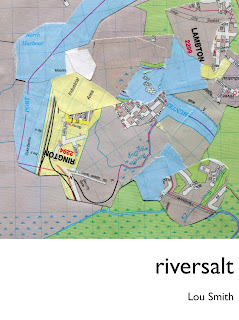
Lou Smith is a Melbourne-based poet of Welsh, Jamaican and English heritage who grew up in Newcastle, NSW. Her poetry has been published in journals and anthologies both in Australia and overseas including Wasafiri, Mascara Literary Review, A Slow Combusting Hymn, Overland, The Caribbean Writer, Nine Muses Poetry, sx Salon, Soft Surface and Caribbean Quarterly. Her book riversalt was published by Flying Islands in 2015.

Lou has worked as an editor and proofreader and was the co-founder of independent publisher Breakdown Press, publishers of political poster series and books such as How to Make Trouble and Influence People: Pranks, Hoaxes, Graffiti and Political Mischief-Making from Across Australia and YOU: some letters from the first five years. 

She is currently working on a number of writing projects including two new books of poetry, one of which is set in her hometown of Newcastle during the Great Depression. 

Lou has a PhD in creative writing from the University of Melbourne where she sometimes teaches. 

 www.lousmith.net

Here are three poems are from my collection riversalt.

An Evening Swim at Kilaben Bay

Between the wooden slats

of the boardwalk

distant lights of houses

blur in a diffraction of amber

like Venus through drizzle

or in the curve of waves

fanning from shore

Sugar

My grandma

sprinkled sugar

on banana fritters

caramelising it in butter

specks of sweetness 

dissolving through batter

into the melting warm fruit

this island was built on sugar

Mum will only eat strawberries

when coated

in enough castor sugar

to form a hot pink pool

in the bottom of the bowl

swirls into thickened cream

like blood entering water

this island was built on sugar

in the day’s heat

men with machetes slice 

through hedges, the cutlass

a legacy from when those

who had been enslaved

cut sugarcane

hands bleeding

like sugary sap

this island was built on sugar

Quarry

The dampness flows  from the hill

the dampness

moulds us

taproot still

the dampness flows

from the hill

and we scoop up water in jars

catch tadpoles with

glutinous eyes

in the quarry

where the men used to mine

with horse and dray

in the quarry

in the heat of summer days

skin off shoulder blades

peels like dried glue sheets

and words hang from trees like rotting vines

not sapped, not blood that drips

and pains amber red

but green and fungal

smelling of carcass flesh

lantana delicate pale pink and lemon,

the scent of not here,

lantana camara, everywhere

in the quarry 

skin pitted on hard small rocks

gravel used for roads

like this cul-de-sac

where time travels in circles

the crow caws

and the bush beckons us

through spotted gums and shade of leaves,

to leave the yellow ochre 

ground,

barren-hard

and walk into the cool

Lou Smith Read More »

Michael Crane

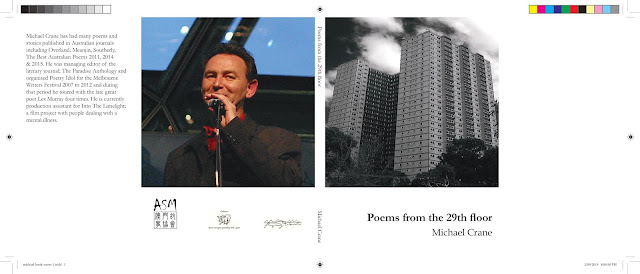
 Michael Crane has made several appearances in Overland, Meanjin, Southerly and numerous other journals and the Best Australian Poems 2011, 2014 & 2015. He has had ten

collections published with small presses since 1998 including his book with Flying Islands called
Poems from the 29th Floor released  December 2019. He organised Poetry Idol for the Melbourne Writers Festival for several years as well as publishing the annual literary journal, the Paradise Anthology. He has an interest in filmmaking and was a production assistant for Into The Limelight which was a series of short comedy films featuring people with a mental illness. He was recently a producer for a film called the Memo Rokumentary.

Michael Crane Read More »

Dominique Hecq

Dominique Hecq grew up in the French-speaking part of Belgium. She now lives in Melbourne. With a BA in Germanic Philology, an MA in literary translation, and a PhD in English, Hecq writes across genres and disciplines—and sometimes across tongues. Her creative works include a novel, three collections of stories, and ten volumes of poetry— Kaosmos (Melbourne Poets Union) and Tracks: Autofictional Fragments of a Journey without Maps (Recent Work Press), both published in 2020 are her latest.

Among other honours such as the Melbourne Fringe Festival Award for Outstanding Writing and Spoken Word Performance, the Woorilla Prize for Fiction, the Martha Richardson Medal for Poetry, the New England Poetry Prize, and the inaugural AALITRA Prize for Literary Translation (Spanish to English), Dominique Hecq is a recipient of the 2018 International Best Poets Prize administered by the International Poetry Translation and Research Centre in conjunction with the International Academy of Arts and Letters.

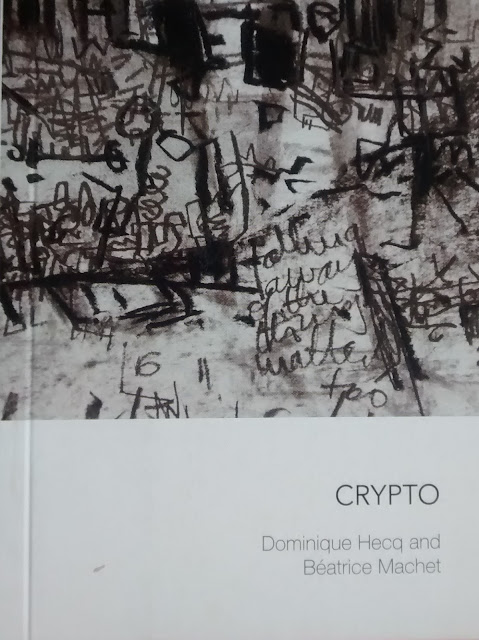
Fencing with Béatrice Machet in 2018, Dominique contributed a bilingual Flying Islands Press pocket book titled Crypto.

Plus proche de l’aube

Attrape le jour par la peau du coup

les retours au bercail ont les dents pointues

bien qu’ignorantes du sens elles mordent et

confondent

les premières rondeurs     avec un premier amour

sombres et douces les paroles

se fondent dans le tourbillon de l’encre

que nous appelons survie

goutte à goutte c’est toi-même reflété et recueilli

aussi noir que le souffle quand il se faufile

entre les crocs

sous le soleil qui louche

si chaud      tu te glisses    à l’intérieur

en fuite   et griffonne

                       au sujet de rencontres

                          interstellaires

un oiseau-arc-en-ciel—qui

ne t’appartient pas—

est ta main     qui salue

que pourrait-elle attraper qui ne s’échapperait

en gribouillant

mais un « je »

avec multiples voix

et personnages sauvant

scénarios et fragments de temps

ou de mort

quelles quantités pour la même chose

mais un I

ceberg en guise de bateau

revendiquant son extériorité

qui fermente jusqu’à ce que gonflé jusqu’à

ce qu’éclaté prématurément

en essayant pourtant d’être plus humain                   

alors que des dents de glace s’écrasent sur le rivage 

Nearer this dawn


Pick up the day by the scruff of the neck

homecomings have sharp teeth


though ignorant of meaning they bite

taking puppy fat            for puppy love


and dark      soft     words

melt in ink swirl we call

survival


drop by drop it is

your very self reflected and gathered

as dark as breath  when it sneaks out

between fangs


under the cross-eyed sun

so hot        you creep       inside

and scribble at large

                         about interstellar

encounters

a rainbow bird—which

doesn’t belong to you—

is your hand      wavering

what could it grasp that wouldn’t escape

through scrawling 


but an I

with multiple voices

and personae salvaging

scenarios and pieces of time

                                  or death


which amounts to the same thing

but an I

ceberg standing for the ship

claiming its outsiderhood

fermenting till swollen till

prematurely split open

 yet trying to be more human 

 as iceteeth crash on the shoreline

Dominique Hecq Read More »

Morgan Bell

Morgan Bell is a Port Stephens author of short fiction. Her books include Sniggerless BoundulationsLaissez Faire, and Intersection Control: Collected Works. She is a qualified technical writer, creative writing teacher, and editor of Sproutlings: A Compendium of Little Fictions. Her first chapbook of visual poetry Idiomatic, For The People was released in 2019. She is due to have a Flying Islands pocketbook of visual poetry published in 2021.

Morgan Bell Read More »

Steve Armstrong – What’s Left

Hi fellow Flying Islanders

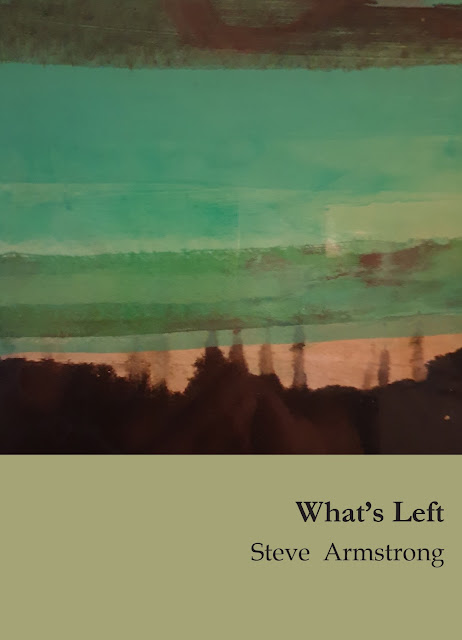
I’m thrilled to have joined your ranks; my pocket book What’s Left was launched December 2020. 

I’m a poet living in Newcastle, who works as social worker/counsellor when I’m not writing.

Dimitra Harvey, poet and editor of Mascara Literary Review launched What’s Left at the Poet’s Picnic in Markwell, and said in conclusion-
   “

For me, Steve’s poetry attends to what Burnside describes as ‘a new science of belonging’ — one that, in his words, puts us ‘back in the open’, seeks ‘to make us both vulnerable and wondrous again — to reconnect us’ with the earth. What’s Lef is charged with that ecological imperative to dwell in and with the rest of the world in a new way.”
This poem Lizards the is taken from the collection.

Lizards

The fetor strikes me first,
and then I find them, a pair of shingle-backs
with armoured scales of polished brown.
They lie close together by the sandy track
that takes me along the high-line of a dry lake.

The smaller of the two is dead.
Mobbing flies and his sinking, say to me,
they’ve spent some time like this.

She’s unflinching.
I stop to wonder how long a novice widow
might keep her vigil. Maybe she’ll go
when he’s lost all resemblance to the one she knew,
or when hunger foreshadows her own decease.
I can imagine a crow might drive her off.

My reductive eye—its blinkered flash—
sees only instinct here.
Even though a pared-back vision is not without
its place,
I’ve feelings for this cold-blooded
couple.

They lived alone much of the year,
then each season, still enchanted—imprints held
in memory—they’d meet up again.
How will she live with what was and is no longer?

I stand by them and the last of the evening
light falls into bed,
true as the lake flats.

Steve Armstrong – What’s Left Read More »

Vaughan Rapatahana (Te Ātiawa)

Vaughan Rapatahana (Te Ātiawa) commutes between homes in Hong Kong, Philippines and Aotearoa New Zealand. He is widely published across several genre in both his main languages, te reo Māori and English and his work has been translated into Bahasa Malaysia, Italian, French, Mandarin, Romanian, Spanish.

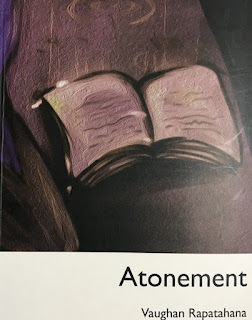
I am a Flying Islands poet – Atonement Macau, 2015.

Right now I am in Mangakino. Lake Maraetai is our mighty lake.

at lake maraetai

these swan

glide in

an ontology

alien to my own.

their empyrean metaphysic,

through all dimensions,

isomorphic

& immutable.

in their majesty

they t r a n s c e n d

       this lake

as they dip deep

    beneath;

as they glissade

with immaculate grace

   a c r o s s  

the      surface;

as they foster

their    funicular   of   cygnets 

in all directions.

this archipelago of swan

transubstantiate

my inauthenticity

into an ecstasy,

I could once

                  never own.

Vaughan Rapatahana (Te Ātiawa) Read More »

Carol Archer

Carol Archer is an Australian visual artist who lives at Markwell in the Myall Lakes region of  N.S.W. Archer’s solo and collaborative works have been exhibited in Australia, Macao, Hong Kong, China, Japan, Sweden, Norway, Spain, Italy and Portugal. Her most recent solo exhibition was Drawing Breath/ Desenhar. Respirar (Sociedade Nacional de Belas Artes, Lisbon, 2017).

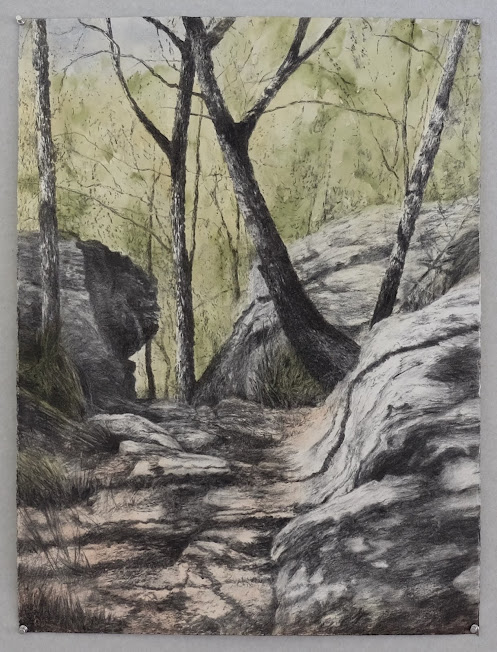
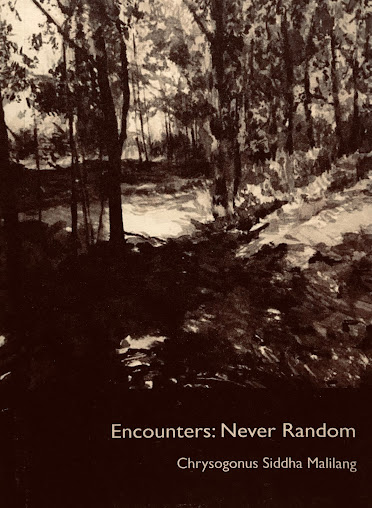
Archer’s recent drawings, prints and paintings explore encounters between groups of trees and the walker who pauses along the way. They explore the sense of immersion, wonder and intimacy of that experience. The hope is that these works evoke viewers’ lived experience of trees and their immense value, at a moment when the need to act decisively to protect fragile Australian ecosystems is crucial.  

For more info and pics visit www.carolarcher.com or Instagram @carolarcher_art 

                                                                                 Carol Archer, 2020, Garigal Walk (after the fires),                                            Charcoal and watercolour on paper, 76 x 56 cm.

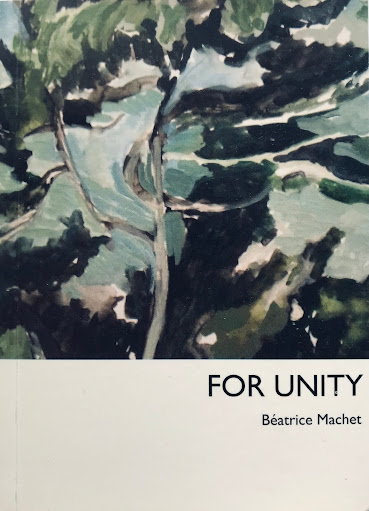
Archer’s work features on the covers of two Flying Island Books: For Unity by Béatrice Machet (2015)

and Encounters: Never Random by Chrysogonus Sidha Malilang (2017). 

Carol Archer Read More »

Alex Skovron

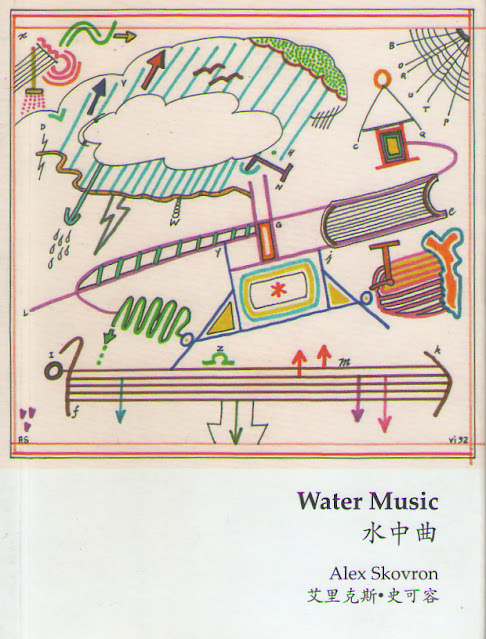
Alex Skovron was born in Poland, lived briefly in Israel, and emigrated to Australia in 1958 aged nearly ten. His family settled in Sydney, where he grew up and completed his studies. From the early 1970s he worked as an editor for book publishers in Sydney and (after 1980) Melbourne. His poetry has appeared widely in Australia and overseas, and he has received a number of major awards for his work. The most recent of his six collections, Towards the Equator: New & Selected Poems (2014), was shortlisted in the Prime Minister’s Literary Awards. His collection of short stories The Man who Took to his Bed (2017), and his novella The Poet (2005, joint winner of the FAW Christina Stead Award for fiction), have been published in Czech translations; The Attic, a selection of his poetry translated into French, was published in 2013, and a Flying Island bilingual volume of Chinese translations, Water Music, in 2017. Some of his poetry has appeared in Dutch, Polish, Spanish, Macedonian and German, and he has collaborated with his Czech translator, Josef Tomáš, on English translations of the twentieth-century Czech poets Jiří Orten and Vladimír Holan. The numerous public readings he has given include appearances in China, Serbia, India, Ireland, Macedonia, Portugal, and on Norfolk Island. An 80-minute CD in which he reads from his work was published in 2019 under the title Towards the Equator. His next poetry collection, Letters from the Periphery, is due in 2021.

Concerns that have driven Alex’s poetry and fiction are many and various: history, language and music; the riddles of time and the allure of memory; philosophy, faith and the quest for self-knowledge; art and the creative impulse; fantasy, eros and the affections. His interest in speculative fiction has played a recurring role in his thinking and his work, as has a lifelong passion for music. As a poet, he enjoys both the disciplines and the aesthetics of formal design and the diverse challenges of freer structures. Integral to his project has been a focus on musicality and the primacy of rhythm. He likes probing the elasticities of syntax, and exploiting the ‘contrapuntal’ layerings available to imagery and meaning via compression, connotation, ambiguity. 

Alex Skovron Read More »

Greg McLaren

I’m a poet whose work has been published almost widely. After Han Shan, my Flying Islands book, is from way back in 2012. Other books include The Kurri Kurri Book of the DeadAustralian ravens and Windfall (Puncher & Wattmann). 

Valley

 After Louise Crisp

 The yards and droughts, they went on forever.

The hills baring themselves from our shame.

Skeletal fruit trees, their juiceless husks, tiny desiccated bats.

Topsoil sloughed and carved off, earth and its wealth found under dug up,

prised out, words slashed through the insides of houses given up on.

A small black dog in the shed outside, something jumping on its roof.

Was that me? The trees behind, between us and the moon-slick rail,

wiping the sky’s underside.

                                          My daughter, a few specks of her glitter

lit on these pages, on a sick day.

                                                  I thought I was free to wander.

Greg McLaren Read More »

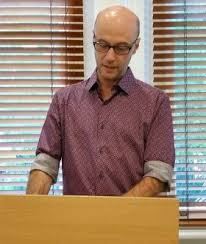
S.K.Kelen

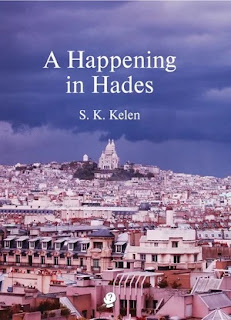
 S. K. Kelen is an Australian poet who enjoys hanging around the house philosophically and travelling. His works have been widely published in journals, ezines and newspapers, anthologies and in his books. Kelen’s oeuvre covers a diverse range of styles and subjects, and includes pastorals, satires, sonnets, odes, narratives, haiku, epics, idylls, horror stories, sci-fi, allegories, prophecies, politics, history, love poems, portraits, travel poems, memory, people and places, meditations and ecstasies. A volume of his new and selected poems was published in 2012. His most recent book of poems, A Happening in Hades, was published by Puncher & Wattmann in 2020.


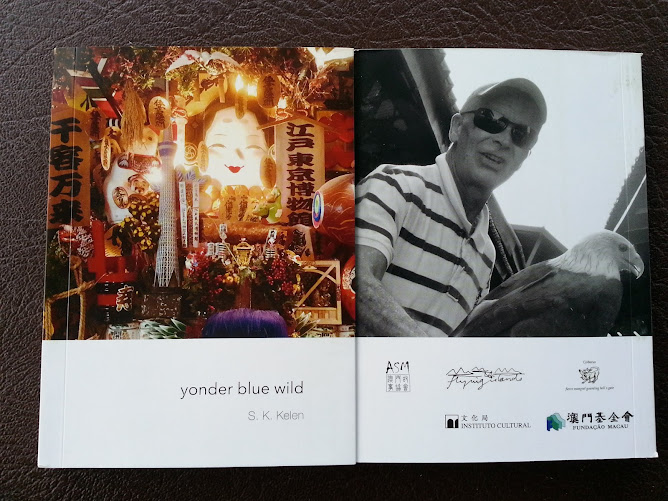
S. K. Kelen’s Flying Islands’ pocket book is Yonder Blue Wild (travel and places 1972 – 2017)

Three poems from Yonder Blue Wild:

Kambah Pool

A bend in the river, water’s clouded by green mud
Deep, really deep, good for proper swimming.
These days only children see spirit life
Work and play, see a world invisible to adults
Clear and just, a solar system glows every grain
Of sand and kids crush evil in one hand,
Until growing up evil comes again.
The light dappling the water surface
Reveals some native spirits’ power
Derives from fireflies. Gumnut babies
Fuss and fight give a lesson how funny
Is the futility of conflict. Children see
That crazy old spirit Pan left his shadow
Hanging from a tree and reflection
Drinking at the river, the old goat’s galloped
Way up mountain, leaps cliff to cliff
Grazes on blackberries growing in the scrub
Gazes over his Murrumbidgee domain.
All glands and rankness, his shaggy coat
Putrid with the smell of ewes, wallabies,
Kangaroos, still a monster, he’ll take
A bird bath later. Dirty musk fills the air
Like a native allergy, tea trees blossom
As he passes, kangaroos lift their heads
Breathe deep his scent and there are dogs, too.
When the kids see Pan they go gulp
If dads could see him they’d beat him to pulp.
You might not see but the musk stench
Wafts on the breeze. Currawongs squawk
The inside-out salute, warble a tone of pity
For the brute. The immigrant god moves inland—
Raucous the cockatoo never shuts up.

Letting Go

The train pulled into Madurai station early

in the morning. She stepped onto the platform

rubbed her eyes dazzled by the sunlight turning

the world white like a clean cotton sheet

she breathed deeply the morning’s incense

and thought it’s true you can smell India all the time.

The morning grew hotter and the light whiter

and the railway platform led to a street

made of dust compacted by a thousand years’

wheels, hooves and feet, the pavement

exploded with ramshackle stalls selling snacks

and bits and pieces, the lime painted buildings,

every now and then a garlanded Shiva or Ganesha.

(Brahmin cows strolled where they damn well pleased).

Thousands of people flowed out of houses

to join the crowd in the street all laughter

and gossip; children ran up hawking

gaudy drinks in plastic bags and paper cones

filled with nuts while old men sold boiled eggs

shouting that their eggs were the best eggs

and some beautiful women in beautiful saris

made tea and offered a cup for fifty rupee.

And in the corner of an eye: the urchins.

Lady Beggar stretched out her hand

breathed slowly a mute scream

performed the first asana from the book

of starvation yoga. Her eyes implored

yet mocked, her lips begged and sneered

her curving right arm pointed

to her mouth then her baby’s mouth,

pointed at her belly then her baby’s belly

she unleashed hunger’s slow ballet,

muttered soft pleas that hypnotised

and tugged the strings a good heart

holds in abundance (there are

many roads to heavenly realms,

not all pleasant). ‘Madam,’ she sang,

‘please madam, just a few pennies

and I can live a while—and my baby’

then the suburban woman’s eyes widened

as she emptied her purse of annas and cents

the beggar yelled delight

suddenly in the air there was a fragrance

like palm wine spilled on a balmy night.

A wild haired man with birds and insects

nesting in his elephantine legs

pointed at the mynah chicks chirping there

shouted ‘Benares! Benares!’

He received her fresh Indian banknotes

with laughing gratitude—

the next fifteen poor souls she gave

all her American dollars & pounds sterling.

The crowd of beggars grew.

Because they were hungry they laughed like crows—

she opened her suitcase and gave away her clothes

signed off the travellers cheques one by one, each

with a teardrop, threw away her camera like a bouquet

and bought every ragged child an ice cream.

The dusty streets are hot with the story.

A young girl asks ‘Can I have your earrings, madam?’

and is given them. A boy runs off with her laptop.

Then it is all white light then out of the light steps

a ragged King Neptune trident in hand

steps lightly through the crowd, waves the beggars on.

‘You are very kind madam those wretches

will live on your money like gods for a day or two

Your hand please — she stared at him and saw

his eyes not only held special intelligence

they reached into her. She came to

and grappled for her master card — lucky.

Her wide eyes narrowed and saw

no matter what she gave away she wouldn’t save

the world, it was weird what she had just done.

The sadhu’s eyes burned like suttee pyres, his muscles

tightened like ropes beneath the dusty rags—in another life

he’d have been a star or a psychopath—

here, he was a strange man in a strange land

He bowed nobly and hailed a taxi.

Megalong Valley

The gods banned machines from ever

entering the last pure tract of Megalong.

Here, even bracken’s picturesque

& the whipbird, breathless

with the beauty of it all,

is silent, reverential.

There’s a waterfall

splashing a rainbow

you walk under

that’s always there and will be

until the earth or sun shifts

sandstone cliffs, a kookaburra

laughs from gorgeous gloom

up & down, up & down.
S.K.Kelen Read More »